

DOMINICAN FRIARS
Philippine Province
Our Founder

St. Dominic and the Order of Preachers
During the 13th Century, Europe is rising in terms of commerce, power and influence. The ideas of pagan Aristotle and his Arab commentators beginning to fascinate the mind of the West. Europe is gradually facing a new world. But in the midst of this new life was also ecclesiastical corruption, despite the efforts of reformers like Innocent III. The new middle class of the cities, skeptical, increasingly educated, materialistic, could not be helped by a clergy that was generally untrained, nor by monastic foundations that were largely rural and, by definition, isolated from the currents of daily life. There was, in the words of Amos the Prophet, “a famine of the hearing of the Word of God” (Amos 8:11), and the vacuum was frequently filled by superstition, divisive heresy, and a love for this world. Various attempts were made to respond to the situation. Groups of diocesan priests living in community, the canons, engaged in parochial and theological work. In a number of places, lay preachers like the poor men of Lyons attempted to return to the simplicity of the early Church and to the Gospel-fervor of its early preachers. But most such lay groups quickly sank into doctrinal error, and had, in the end, to be suppressed.
It was in such a world that Dominic Guzman grew up, the son of a Spanish noble. Dominic was born in 1170 in Caleruega, Spain. He received his early education in Palencia. As a philosophy student, we heard of the famous story that he sold his books to buy food for the starving. News of Dominic's virtues reached the Bishop of Osma, who summoned Dominic and made him a Canon Regular of his church. Lead by Diego de Acebo, the prior of the community, he learned the basics of religious life and contemplation.
Diego became bishop of Osma and invited Dominic to travel with him as he spread the Gospel. Together in 1206, both men offered Pope Innocent III their services to save souls. The pope asked them to go preach to the Cathars of Languedoc. Contrary to the habits of the Cistercians, Dominic and Diego roamed the villages of Languedoc on foot, begging their bread.
Diego soon died, but Dominic continued to preach with the help of a community that had gathered in 1207 and was comprised of women who fled the Cathars and lived the common life in Prouilles. To preach the gospel better, in 1215 Dominic moved on to Toulouse with a few companions that were bound to him by profession. Soon they adopted a rule of life, based on that of St. Augustine. In a bull entitled Religiosam Vitam, dated December 22, 1216, Pope Honorius III confirmed the Order as an Order of Canons Regular. In 1217 Dominic dispersed the brothers two by two to further the preaching mission. They were sent “to study, to preach and to found communities.” To train the best brothers in the preaching, Dominic chose to settle in two large university cities: Paris and Bologna.
Dominic continued to travel between Spain and Rome to establish the Order's foundation. In 1220, delegates of the brothers gathered in Bologna to approve the first constitutions, the first laws governing the operation of the college. Dominic died in Bologna in 1221. Dominic died but his light continues to enlighten through the growing number of the Dominican Family in the World.
The Dominicans in the Philippines
Christianity first reached these islands in 1521 with the arrival of Ferdinand Magellan and his party. It was, however, only in 1587 that the first permanent Dominican mission reached the island of Luzon. The first Spanish friars dedicated themselves to the Christianization of the natives, as well as of the several foreigners who were living among them, notably the Chinese. These Dominicans formed the
Province of Our Lady of the Holy Rosary.


The Philippine Province
Following almost four hundred years of Spanish Dominican mission in these islands, the Dominican Province of the Philippines (Ordo Praedicatorum – Provincia Philippinarum) is the forty-first Province of the Order, canonically established on 08 December 1971, in a solemn ceremony at Santo Domingo Church, Quezon City, Metro Manila. The Province was to be the indigenous home of native Filipino Dominicans, as well as a training ground for future Dominican missionaries in nearby countries. Today, the Province ministers in the Philippines, Sri Lanka, and Indonesia.

The Dominicans in the Philippines


Vision - Mission Statement of the Dominican Province
of the Philippines
We, the brothers of the Dominican Province of the Philippines, committed to become an authentic community of preachersin the service of the Church, strive to incarnate in ourselves and in our communities Jesus Christ, the Preacher, whom we announce to the world, especially to the poor through an inter-cultural Dominican way of witnessing and proclamation.
– Fundamental Statute III

The Dominican Family


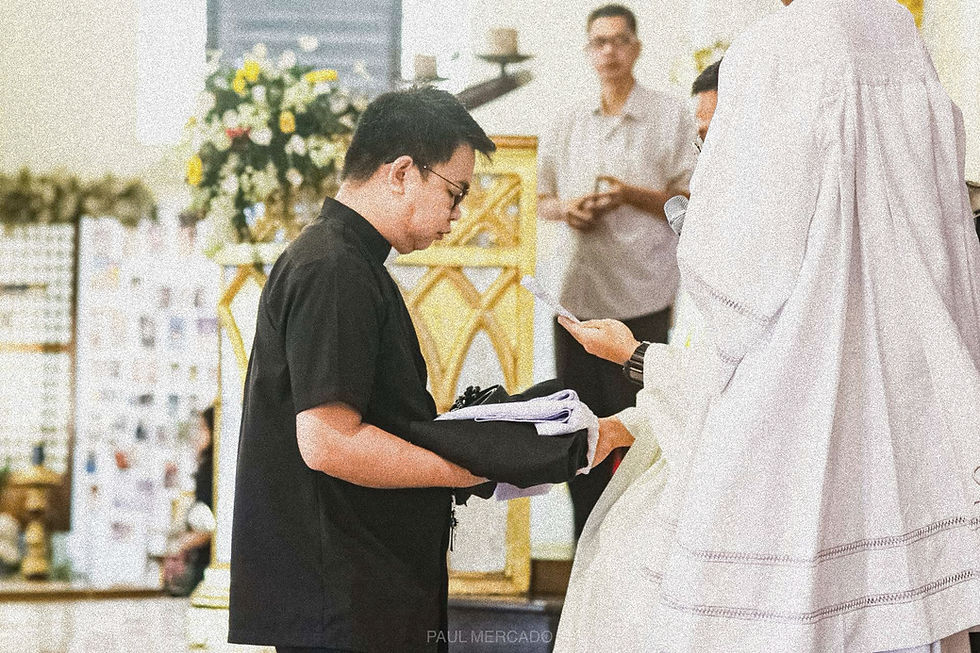
The Dominican Family in the Philippines is composed of the Dominican friars, nuns, the clerical confraternity, apostolic sisters, and lay Dominicans. In recent years, the Family has continued to grow and strengthen its mission of preaching, ministering, and promoting vocations by acting together and supporting one another.
Various platforms have fostered this collaboration, such as the Dominican Formators Conference of the Philippines, the Justice, Peace and Care for Creation Commission of the Dominican Family, and the Dominican Network of Schools (DOMNET). These initiatives create spaces where members can work hand in hand in formation, education, mission, and advocacy.
The Dominican Family also gathers for formation and celebration. The Dominican Juniors Formation Encounter allows young Dominicans in formation to come together to share their experiences and the fruits of contemplation and study. Regular gatherings happen on significant feast days of the Order and the Province, such as the Solemnity of St. Dominic, the Solemnity of the Immaculate Conception (which also marks the anniversary of the Dominican Province of the Philippines), as well as during retreats, ordinations, professions, jubilees, and other special milestones.
The Dominican Family also unites in preaching and ministry. The iLumen Blog(http://ilumenpreachingblog.blogspot.com) serves as the official online preaching platform of the Dominican Family, featuring reflections from friars, nuns, sisters, the lay faithful, and the clerical confraternity. As one Family, the Dominicans also reach out in times of need. For example, after Typhoon Yolanda (Haiyan) in 2013, Dominican communities provided assistance to members who were affected, enabling them to continue their ministry and relief work in devastated areas. Another powerful witness of shared mission is the “Siete Palabras”, the annual Good Friday preaching on the Seven Last Words of Christ. Broadcast on national television, it not only garners high viewership but also showcases the richness and diversity of Dominican vocations in the Philippines.
The contemplative branch of the Family is represented by the nuns, who pray unceasingly for the Church and the world. In the Philippines, they are present at Our Lady of the Angels Monastery in Bocaue, Bulacan, and Our Lady of the Rosary Monastery in Cainta, Rizal.
The Dominican Laity continues to flourish, with the addition of six new chapters. The Priestly Fraternity of St. Dominic has likewise expanded, now with 264 priests and bishops as members (as of August 2025). Meanwhile, the Dominican Network of Schools, Colleges, and Universities (DOMNET) continues to grow, gathering students annually for youth festivals, leadership training, recollections, and outreach activities, strengthening the Dominican spirit among the youth.
Indeed, the Dominican Family in the Philippines embodies the vision of St. Dominic by remaining united in diversity, committed to the preaching of the Gospel, and steadfast in building a future rooted in faith, truth, and service.

Thrusts of the Province
Thirteenth Provincial Chapter
Christ the Preacher of Hope
CHRISTUS PRAEDICATOR SPEI, thus, declares the most recent General Chapter of the Order (ACG 2022 Tultenango, 57). Indeed, Christ is the Preacher of Hope! "He brings the glad tidings to the poor" (Isa 61 :1; Luke 4:18-19). And by his coming, Christ is the Hope of Preaching, Hope incarnate, "whom we hear and see, touch and bear witness to" (1 John 1-2).
In the Order of Preachers, Dominic has promised us that "Wonderful Hope," O Spem Miram, of presence abiding, grace outpouring, help assuring, over and beyond death, darkness, difficulty, and despair.
In this Jubilee Year, this is the Hope we celebrate with gratitude, the Hope we preach, the Hope we bear in our pilgrimage, the Hope we "proclaim persistently in season and out of season, convincing, rebuking, and encouraging, with the utmost patience in teaching" (2 Timothy 4:2).

In the spirit of the apostles, we will "proclaim the kingdom of God and teach about the Lord Jesus Christ with all boldness and without hindrance." (Acts 28:31) Through this 13th Provincial Chapter, we thrust ourselves to become PREACHERS OF HOPE in our communities and institutions. We will strive to develop Caleruega and Surabaya and the UST Ecclesiastical Faculties as centers of preaching in the Philippines and in Asia-Pacific.
"Always be ready to give an account for the reason for your hope" (1 Peter 3: 15). Through this 13th Provincial Chapter, we thrust ourselves to cultivate a culture of vocation promotion - giving an account of our hope, nourishing our own religious formation as well as drawing people through authentic Christian witness, preaching through our lives, living our hope, integrating and strengthening our formation both initial and permanent, exercising fraternal care especially to our brethren who are weak, infirmed, aged, and in crisis.
"Therefore let us encourage one another and build up each other" (1 Thess 5: 11 ). Through this 13th Provincial Chapter, we thrust ourselves to build our communities and institutions as centers of strategic management, stable and sustainable, dealing with the challenges of integrating apostolates, synergizing our efforts, and engaging emerging technologies such as artificial intelligence. The hope we preach leads us to confront the difficulties of our communities and the Province. Notably, we shall respond concretely and judiciously to the challenges of our institutions in need of assistance. This same hope raises our vista towards the future, when our houses in Indonesia would become a Provincial Vicariate within the next ten years.

"Enlarge the space of your tent, stretch your tent curtains wide, do not hold back; lengthen your cords, strengthen your stakes" (Isa 54:2-3). Through this 13th Provincial Chapter, we thrust ourselves to deepen and expand our collaboration between and among fellows, communities, institutions, both local and international. In hope, we commit to the mission of preaching to the "existential peripheries," to new frontiers in Asia-Pacific, even in Europe, and wherever the Spirit leads us.
Through these thrusts, we shall work and "wait for the Lord, renew our strength, soar with eagles' wings, run and not be weary, walk and not faint" (Isa 40:31 ). By the promised prayer of St. Dominic, we hold on to this Wonderful Hope, preaching boldly and unhindered "Christ who is our Hope" (Col 1 :27).